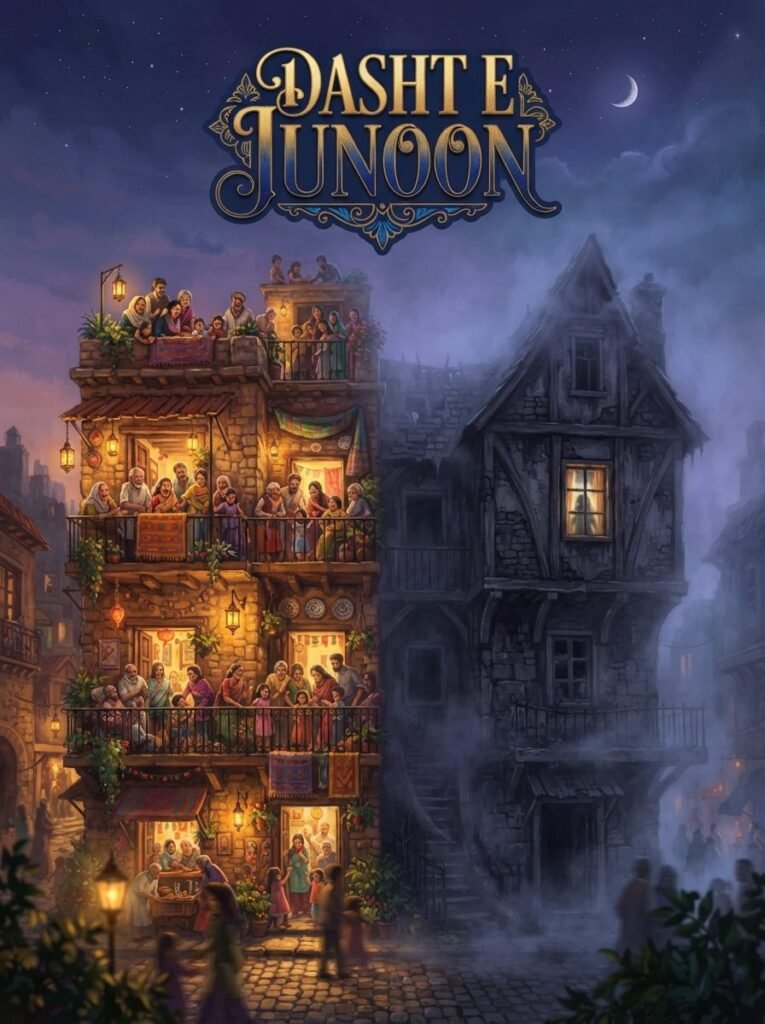
A wilderness of madness is a strange name for a joint family romance, until you learn that half the story takes place in a building people swear is haunted. Amna Riaz spreads Dasht e Junoon across more than eight hundred pages and two very different buildings, mixing everyday household rivalry with a real ghost story and a slow burn revenge plot. It ran for thirty episodes in a monthly digest before becoming a full book, and readers still argue over which of its two timelines they liked more.
Main Characters
- Khush Naseeb: lives in Fazal Manzil with her mother and sister, and she is the backbone the whole novel is built around. Her refusal to live by other people’s rules gives the story its spine.
- Muaavia: lives in the building known as Falak Boss, and his story is the supernatural heart of the novel, tangled up with the fears and unexplained events that give the building its reputation.
- Wasama and Aayat: a married couple who also live in Falak Boss, and their household adds its own mystery to a building already unsettled by ghost stories.
- Khushnaseeb and Kaif: cousins who carry a revenge storyline that runs alongside the main plot, giving the novel its second major thread.
- Munfira, her family, and her friends: they round out the wider cast that fills Fazal Manzil’s joint household with warmth, jealousy, and rivalry in equal measure.
Story Summary
Dasht e Junoon opens across two housing buildings that could hardly be more different. Fazal Manzil is home to a joint family in the traditional sense, several relatives living under one roof, sharing meals, jokes, and old grudges the way large families do. Amna Riaz writes that household with real affection, letting the warmth of many relatives coexist with the jealousy and interference that closeness like that always seems to breed, especially once a young and handsome guest arrives and upsets the balance.
Across the way sits Falak Boss, a building with a very different reputation. People who live there, including Muaavia and the married couple Wasama and Aayat, claim to have witnessed things that do not have an easy explanation, and the building’s owner, Muaavia’s cousin, carries a story of his own that only gets stranger the closer the novel looks at it. Running underneath both settings is a second, more personal thread involving cousins Khushnaseeb and Kaif, whose story is driven by revenge rather than romance, and whose history explains a great deal about how Muaavia first crossed paths with the rest of the cast.
Khush Naseeb, watching all of this from inside Fazal Manzil, refuses to simply accept the roles and rules everyone else seems willing to live by, and that defiance is what pulls the joint family drama and the haunted building’s mystery into the same orbit. Amna Riaz keeps three kinds of tension running side by side, the everyday friction of a shared household, the unresolved fear surrounding Falak Boss, and the private battle between courage and fear inside her characters, before finally tying the ghost story, the joint family romance, and the old revenge plot together by the novel’s end.
Central Themes
- Defiance inside a traditional household: Khush Naseeb’s refusal to live by everyone else’s expectations gives the joint family half of the story its real conflict.
- Fear made real: Falak Boss is treated as a genuine haunted setting rather than a rumor, and the novel leans into that supernatural thread rather than explaining it away.
- Revenge that reaches across generations: Khushnaseeb and Kaif’s cousin storyline shows how an old grudge can still be shaping the present long after it started.
- Closeness with a cost: The novel is honest about how a shared household brings warmth and rivalry in the same breath, never pretending joint family life is simple.
- Courage tested by the unknown: Characters throughout the novel are measured by how they respond to fear, whether that fear comes from ghosts, family, or the past.
Final Thoughts
Dasht e Junoon earns its length by genuinely needing the space, weaving a joint family saga, a haunted house story, and a cousin revenge plot into one novel without letting any of the three feel like filler. Amna Riaz gives Khush Naseeb real backbone and lets Falak Boss stay properly unsettling throughout, which is exactly why readers describe finishing all eight hundred pages without losing interest. If you want an Urdu romance that reaches past the drawing room into real suspense, this one is worth the commitment.
More Urdu Novels to Read
Real fear woven straight into the family drama fills the Horror Based Novels collection on this site. Where to go next: