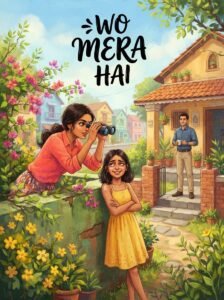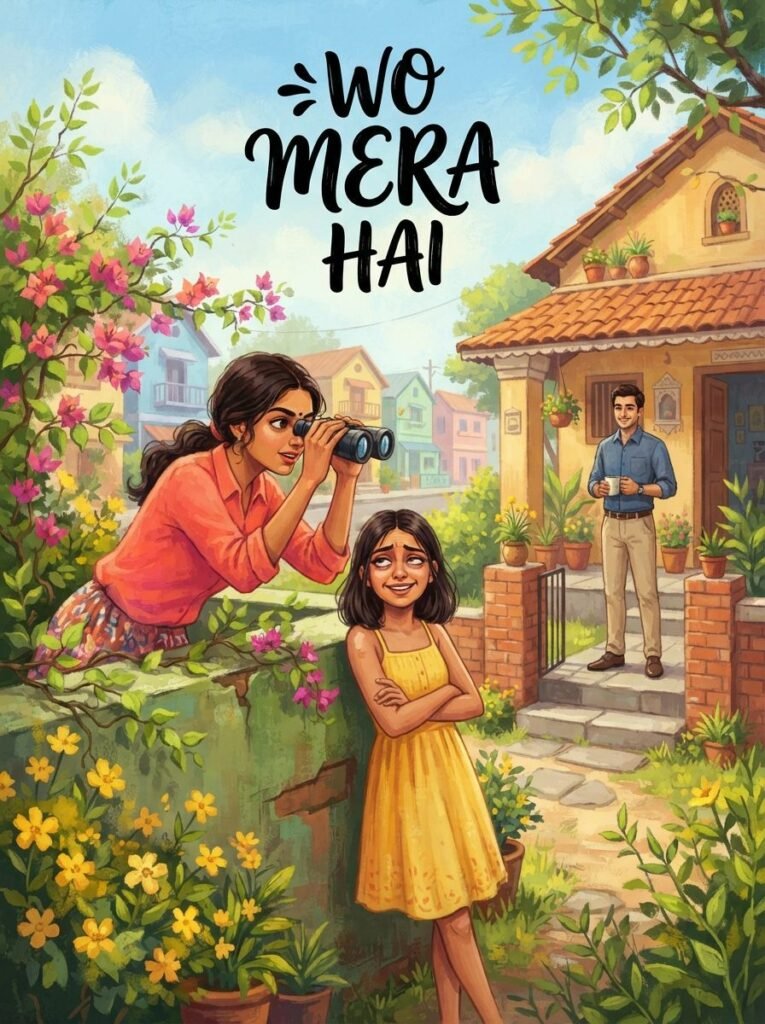
Not every Nimra Ahmed story needs three hundred pages to land. Wo Mera Hai is barely fifty, written early in her career, and it trades her usual suspense and spiritual weight for something lighter, a cousin’s overactive imagination, a mysterious new neighbor, and a romance that sneaks up on everyone involved. Readers often compare it to Umera Ahmed’s Aisa Bhi Hota Hai, calling it Nimra Ahmed’s own turn at a pure romantic comedy.
Main Characters
- Umme Hani: known simply as Hani, is the story’s judgmental, endlessly curious lead, convinced she can see through people at a glance and determined to prove it once a strange new neighbor moves in next door.
- Nageen: Hani’s cousin, visiting for the holidays and, in Hani’s eyes, hopelessly old fashioned. Nageen’s quieter presence is what gives Hani’s schemes their audience and, eventually, their comeuppance.
- Farhad Hassan: the neighbor at the center of Hani’s suspicion, a man she becomes convinced is a terrorist hiding something sinister, though the truth turns out to be far simpler, and far more romantic, than anything she imagined.
Story Summary
Wo Mera Hai opens with Hani spending her holidays at her khala’s house, reunited with her cousin Nageen after several years apart. Hani has not forgotten the version of Nageen she knew before, and she is quick to decide her cousin is still the same old fashioned girl she remembers, never suspecting that assumption is about to be turned back on her.
Their days together take a turn once a mysterious, good looking new neighbor moves in. Hani’s inner detective wakes up instantly, and she becomes convinced there is something suspicious about him, going so far as to suspect Farhad Hassan of being a terrorist hiding dangerous secrets behind his ordinary routine. With Nageen pulled reluctantly along for the ride, Hani sets out to investigate, eavesdropping, snooping, and misreading nearly everything she overhears, including a phone call that convinces her she has caught him in the act.
Of course, every clue Hani gathers leads her further from the truth and closer to embarrassing herself. As the misunderstandings pile up, Nimra Ahmed lets the comedy do most of the work, right up until Hani’s suspicion quietly gives way to something else entirely. Farhad turns out to be nothing like the villain she imagined, and what began as a ridiculous investigation slowly turns into real, unexpected affection between them. The story wraps up quickly and warmly, true to its short novella length, closing on the kind of sweet, funny note Nimra Ahmed rarely gets credit for outside her longer, more serious work.
Central Themes
- Judgment that says more about the judge: Hani’s assumptions about both Nageen and Farhad repeatedly backfire, showing how quickly snap judgments can lead someone astray.
- Suspicion turning into affection: The novel’s central joke, that Hani’s investigation of a supposed terrorist actually leads her toward love, plays with how easily fear and attraction can get tangled together.
- Cousins and old assumptions: Hani and Nageen’s dynamic pokes fun at how people cling to outdated impressions of family members they have not seen in years.
- Comedy without heavy stakes: Unlike much of Nimra Ahmed’s other work, the novel deliberately avoids tragedy or deep spiritual weight, aiming purely for warmth and laughter instead.
- Love found in the most unlikely setup: True to its title, the story insists that real connection can grow out of the most absurd circumstances, here a mistaken terrorism plot.
Final Thoughts
Wo Mera Hai proves Nimra Ahmed can be genuinely funny when she wants to be, wrapping a full, satisfying romantic comedy into just fifty pages. Hani’s overactive imagination and Farhad’s patient good humor make for an easy, breezy read, and Nageen’s presence keeps the whole thing feeling like real cousins bickering rather than a forced setup. If you want a quick, lighthearted introduction to Nimra Ahmed’s writing, or just need a short story to read in one sitting, Wo Mera Hai is a perfect choice.
More Urdu Novels to Read
Nimra Ahmed’s other work sits alongside the rest of the Islamic Based Novels collection here. Where to go next: