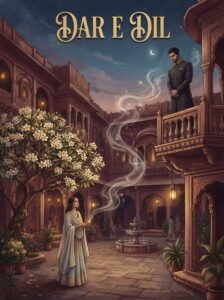
Alif is the first letter of the Arabic alphabet, and Umera Ahmed uses it here to represent something much larger: the beginning of a return to faith. Spread across twelve episodes and multiple generations, the novel follows a celebrated but spiritually lost filmmaker whose search for his mother’s true story ends up becoming a search for his own soul. It remains one of Umera Ahmed’s most ambitious and widely discussed works.
Main Characters
- Qalb e Momin: the novel’s central figure, a hugely successful commercial film director known for objectifying women in his movies and living without much regard for faith, despite once being a child who wrote innocent letters to Allah. His journey from spiritual emptiness back toward belief drives the entire novel.
- Momina Sultan: a talented, reluctant actress supporting her family through work she does not particularly enjoy. Her path repeatedly crosses with Qalb e Momin’s, first through conflict and later through a connection neither of them expects.
- Husn e Jahan: Qalb e Momin’s mother, once the reigning queen of the Pakistani film industry, her own story of beauty, ambition, and love shaping the very film her son sets out to make about her.
- Taha Abdul Aala: a whirling dervish and Qalb e Momin’s father, whose love for Husn e Jahan and devotion to spirituality stand in sharp contrast to the worldly life his son later chooses.
- Abdul Aala: Qalb e Momin’s grandfather, a calligrapher from a long line of calligraphers, whose quiet influence keeps gently pulling Qalb e Momin back toward faith even when his grandson refuses to listen.
- Sultan: Momina’s father, who works as a makeup artist and quietly carries his own decades old, unspoken love for Husn e Jahan, adding another layer to the story’s tangled history.
Story Summary
Qalb e Momin has spent his career as one of Lollywood’s most successful directors, building an empire on commercially profitable films while ignoring the faith he was raised around. Haunted by fragmented childhood memories and a troubled understanding of his mother, Husn e Jahan, he decides to make a film about her life, believing for years that she was simply a bad mother who abandoned him after his father’s death and remarried.
To play his mother, Qalb e Momin’s search eventually leads him to Momina Sultan, an actress whose own path has been shaped by financial hardship and a career she never particularly wanted. Their first meeting is anything but pleasant, with Momin rejecting her at an audition, but fate brings them back together once Momina rises to fame on her own. As they begin working on the film together, real feelings start forming between them, complicated further when Momin misreads her friendship with his assistant and confronts her in anger, nearly ending their collaboration before it can go anywhere.
As the script comes together, the story pulls back further into the past, revealing that Momina’s father, Sultan, has loved Husn e Jahan in silence for decades, following her career as her makeup artist without ever speaking his feelings aloud. Husn e Jahan’s own history unfolds alongside this, tracing her rise as a celebrated actress, her chance encounter with Taha Abdul Aala’s spiritual performance in Turkey, and the deep, unlikely love that grew between an actress and a dervish. As Qalb e Momin uncovers the full truth about his parents, his understanding of his mother, his faith, and his own identity begins to shift, and the film he set out to make becomes something far more personal than he ever intended.
Central Themes
- The return to faith after worldly ambition: Qalb e Momin’s arc from a spiritually empty director to someone reckoning with belief again forms the emotional backbone of the novel.
- Truth hidden across generations: Nearly every major revelation in the story comes from uncovering what an earlier generation kept silent, tying the past directly to the present.
- Love expressed through sacrifice and silence: Sultan’s decades long, unspoken devotion to Husn e Jahan reflects a recurring idea in the novel that real love does not always announce itself.
- Fame and its spiritual cost: Both Momina and Husn e Jahan navigate the entertainment industry’s demands while quietly searching for something more meaningful than success.
- Divine connection symbolized by Alif itself: The novel’s title reflects its larger message, that every complicated human story can still circle back toward a single point of spiritual beginning.
Final Thoughts
Alif stands apart in Umera Ahmed’s body of work by weaving together several equally weighted stories, Qalb e Momin and Momina’s, Husn e Jahan and Taha’s, Sultan’s quiet devotion, into a single meditation on faith, fame, and redemption. The novel never fully settles on whose story matters most, and that refusal to simplify is exactly what gives it such lasting depth. If you enjoy Umera Ahmed’s other spiritually driven work, particularly Peer e Kamil, Alif offers a similarly profound journey told through a very different lens.
More Urdu Novels to Read
Umera Ahmed’s other work sits alongside the rest of the Islamic Urdu novels collection here. Where to go next: