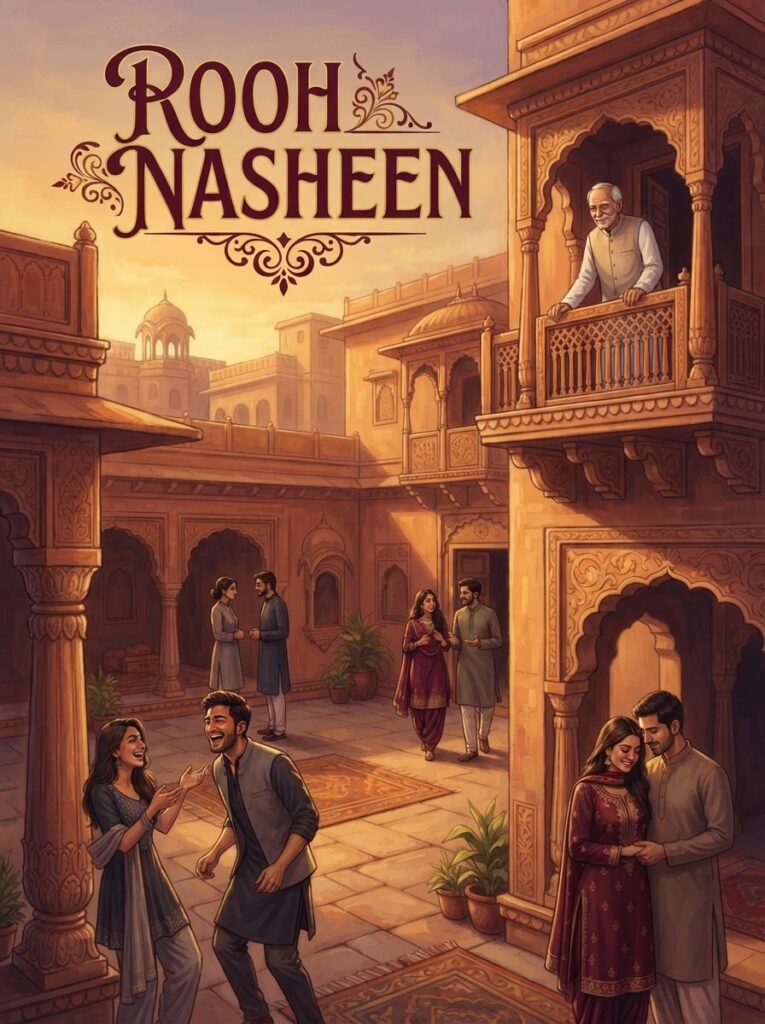
Rooh Nasheen means the one who settles into the soul, and S Merwa Mirza takes that title seriously, building an entire haveli’s worth of forced marriages around the idea that real love, once it finds a place in someone, does not easily leave. Four couples, a haveli patriarch, a lifelong friendship, and careers ranging from the police force to medicine all get folded into one sprawling romance and revenge saga.
Main Characters
- Feroz Shamsheer: heads the haveli as its respected elder, watched over every morning by Aizel Maryam, the household’s eldest daughter-in-law, known affectionately as Aai Jaan, and his wife Kanwal, whose patience with her husband’s early morning moods is its own quiet running joke.
- Ozaan: bound to Zeinish in one of the novel’s four central pairings, his blunt question to her, about when she will finally let herself come closer, captures the hesitant, guarded tone of their entire relationship.
- Alman and Mashaim: also called Meshi, they make up a second couple whose playful bickering, over something as small as a sari, brings real warmth and humor into an otherwise intense story.
- Haseeb: Ozaan’s close friend, anchors a friendship that readers point to as one of the novel’s real strengths, lifting the story with loyalty that runs alongside its romantic threads.
Story Summary
Rooh Nasheen is built around a haveli and the four forced marriages that bind its younger generation together. At the top of the household sits Feroz Shamsheer, whose presence commands quiet respect each morning from Aizel Maryam and his wife Kanwal, setting the tone for a family that values tradition even as its younger members chafe against it. None of the four couples inside this household chose their partners freely, and S Merwa Mirza spends the novel tracing how differently each pair responds to that shared circumstance.
Ozaan and Zeinish’s story leans hardest into the emotional caution suggested by the book’s title, their connection built on hesitation and quiet longing rather than easy affection. Alman and Mashaim’s relationship, by contrast, carries real humor, their teasing arguments giving the novel some of its lightest, most enjoyable moments even as the larger plot deals with revenge, hatred, and difficult family history. Around these two central couples, two more pairings unfold, drawn from professions including the police, the army, and medicine, each bringing their own version of duty and personal sacrifice into a story already carrying real political and religious undertones.
As the different threads develop, the hero at the emotional core of the novel, damaged by his past and slow to trust anyone, comes to understand that the very vulnerability he once saw as weakness is actually where something greater has taken root, a realization that gives the book its title. Revenge and old hatred keep testing every couple throughout, but S Merwa Mirza builds toward an emotional resolution where pain, regret, and love finally confront each other directly, proving, as the ending insists, that real love outlasts even long held revenge.
Central Themes
- Multiple forced marriages, one shared lesson: By following four couples at once, the novel shows several different ways people can build real connection out of a bond they never chose.
- Vulnerability mistaken for weakness: The hero’s arc, and the novel’s title, rest on the idea that what looks like emotional fragility can actually be the place where real strength and love settle in.
- Friendship as its own kind of loyalty: Haseeb and Ozaan’s bond runs alongside the romantic storylines, giving the novel warmth that does not depend on any one couple’s success.
- Humor beside hardship: Alman and Mashaim’s lighter dynamic balances out the novel’s heavier themes of revenge and generational hatred.
- Love that outlasts revenge: The novel’s ending insists directly that whatever pain and grudges shaped its characters, genuine love proves the stronger force by the final pages.
Final Thoughts
Rooh Nasheen earns its considerable length by giving four different couples real room to work through forced marriage, old family hatred, and slow building trust, all inside the same haveli. S Merwa Mirza balances Ozaan and Zeinish’s cautious intensity against Alman and Mashaim’s warmer humor, while Haseeb’s friendship and Feroz Shamsheer’s steady household presence hold the wider family together. If you enjoy big, multi-couple Urdu sagas built on forced marriage, revenge, and a genuinely emotional payoff, Rooh Nasheen is a rewarding, immersive read.
More Urdu Novels to Read
The rest of S Merwa Mirza’s catalog sits alongside the wider Haveli and Wadera Based Novels collection here. Where to go next: