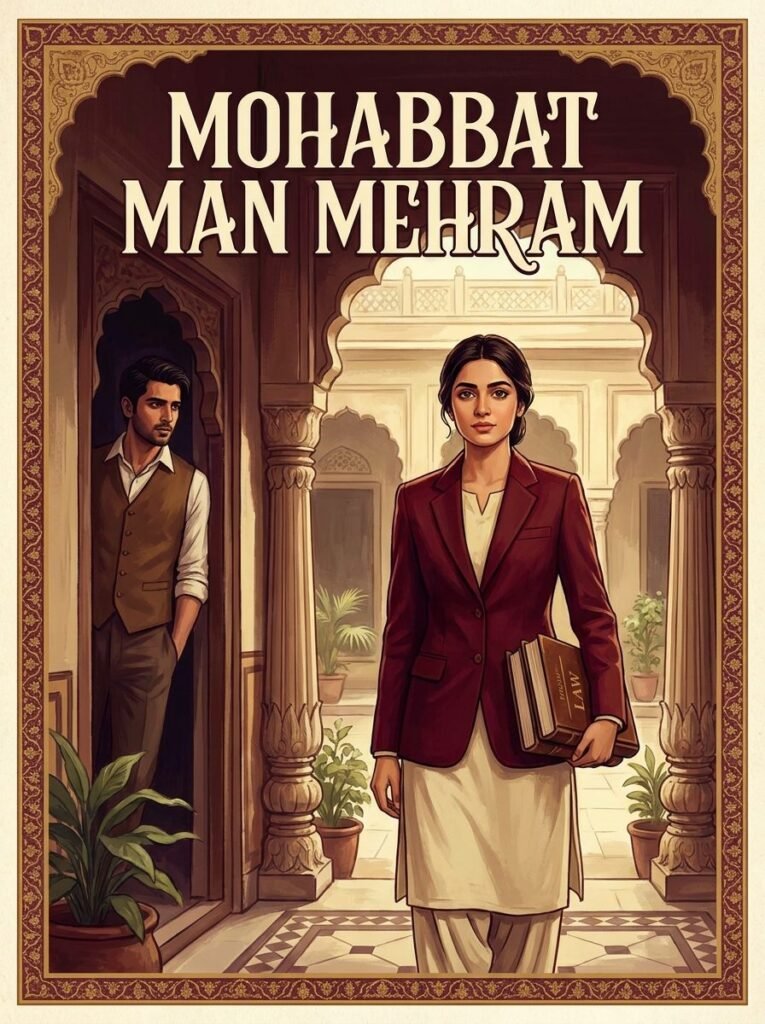
Mohabbat Man Mehram treats love as something closer to sacred trust than simple attraction, and Zainab Rajpoot builds an entire feudal family saga around that idea. Centered on the Malik household and the old wounds still shaping its younger generation, the novel follows several couples working through revenge, injustice, and family expectation at once. It has become known for handling romance with real restraint, keeping its love stories respectful even as the drama around them runs high.
Main Characters
- Shamshair: only twenty nine, yet he already carries the full weight of protecting the Malik family, a feudal household shaped by years of difficult history. Driven by a quiet need for revenge over past betrayals, he keeps a careful, watchful eye on the people closest to that history, including the woman he cannot stop thinking about.
- Aqedat: a bold, kind hearted lawyer who fights for women’s rights, entirely unaware that her own parents’ past actions played a role in the Malik family’s downfall. Her strength and conviction make her someone Shamshair cannot simply use for his revenge plan without complication.
- Balaj and Chahat: cousins bound by family ties, they add their own romantic thread to the wider Malik household story.
- Manat and Rab: they round out the central group, their relationship complicated by the fact that Rab’s own parents married against family wishes, leaving behind tension that follows into the next generation.
Story Summary
Mohabbat Man Mehram centers on the Malik family, a feudal household whose past is tangled up in betrayals that still shape how its younger generation moves through the world. Shamshair, despite being just twenty nine, has already taken on the responsibility of protecting his family’s name and standing, and part of that responsibility includes a quiet, deliberate pursuit of revenge against those he believes wronged the Maliks in the past.
That pursuit brings him directly into Aqedat’s orbit, a lawyer known for fighting on behalf of women’s rights, whose boldness and conviction make her impossible for Shamshair to simply observe from a distance. What he knows, and she does not, is that her own parents’ choices years earlier are tied to the very downfall he is determined to avenge. As Shamshair keeps watch over her, ostensibly as part of his plan, real feeling starts complicating what was meant to be a calculated strategy, forcing him to weigh his family’s old wounds against the woman he is falling for despite himself.
Around this central storyline, Zainab Rajpoot weaves in the parallel struggles of Balaj and Chahat, cousins navigating their own version of family expectation, and Manat and Rab, whose relationship is shadowed by the consequences of Rab’s parents marrying against their family’s wishes years before. Each couple works through a different flavor of the same core tension, personal desire pressed up against inherited family history, and the novel moves between their stories to build a fuller picture of how deeply the Malik family’s past continues to shape its present.
Central Themes
- Revenge complicated by genuine love: Shamshair’s calculated pursuit of Aqedat as part of his revenge plan becomes increasingly difficult to sustain once real feeling enters the picture.
- Inherited consequences across generations: Aqedat’s ignorance of her parents’ role in the Malik family’s downfall shows how the past can shape a relationship before either person fully understands why.
- Multiple love stories under one family roof: By following Shamshair and Aqedat alongside Balaj and Chahat, and Manat and Rab, the novel shows several different ways personal desire collides with family history.
- Respectful, halal romance: True to its reputation, the novel keeps its central relationships grounded in dignity and restraint rather than leaning on melodrama for its own sake.
- Strength through conviction: Aqedat’s work advocating for women’s rights gives her a clear sense of purpose that stands independent of her connection to Shamshair, making her far more than simply the object of his plan.
Final Thoughts
Mohabbat Man Mehram has earned its popularity by grounding a genuinely dramatic feudal family saga in real restraint, letting Shamshair’s revenge plot and Aqedat’s own convictions collide without losing sight of the novel’s respectful tone. Zainab Rajpoot gives each of her three central couples enough space to feel distinct, tying their individual struggles back to the same family history running underneath the entire story. If you enjoy Urdu fiction that blends feudal drama, multiple intertwined romances, and genuinely halal love stories, this novel delivers all three in one satisfying read.
More Urdu Novels to Read
Feudal households where old grudges shape every marriage fill the Haveli and Wadera Urdu novels section here. Where to go next: