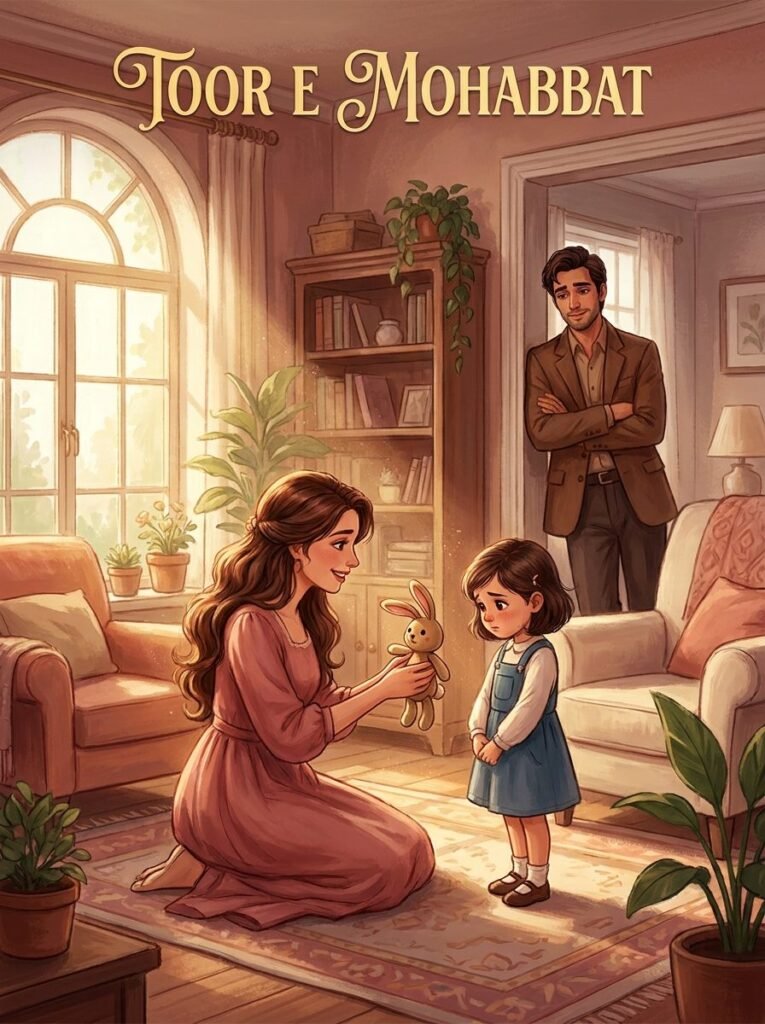
Toor e Mohabbat means the manner or way of love, and Memona Nasrullah spends the novel showing just how many different shapes that manner can take. Built around a second marriage nobody involved is happy about at first, the story follows a widower still grieving his first wife and the woman forced into becoming a stepmother to a child who wants nothing to do with her. It has stayed a reader favorite for how honestly it handles blended family pain.
Main Characters
- Noor Fatima: soft hearted yet dignified, pushed into a second marriage by circumstances entirely outside her control. Her patience in the face of coldness and rejection becomes the emotional center of the novel.
- Hamad Ali: serious and responsible, still carrying real wounds from his first marriage when he starts this new chapter of his life. His inability to see Noor as anything more than a formal arrangement at first shapes much of the story’s early tension.
- Aisha: Hamad’s young daughter, who does not accept Noor easily, viewing her as a replacement for the mother she still misses rather than someone worth trusting.
- Saira Begum and Fariha: Hamad’s traditional minded mother and Noor’s supportive sister, who round out the family dynamics surrounding the couple, each shaping the pressures and small comforts Noor experiences along the way.
Story Summary
Toor e Mohabbat begins with Noor Fatima living a simple, unremarkable life until family circumstances and social pressure force her into a decision she never wanted for herself. She is married off to Hamad Ali, a widower still trapped in memories of his first wife, someone who has built his entire sense of purpose around raising his young daughter, Aisha. To Hamad, Noor’s arrival barely registers as anything beyond a formal bond, and the household settles into a cold, distant atmosphere that leaves little room for genuine connection.
Aisha’s resistance only deepens that distance. Too young to separate grief from resentment, she pulls away from Noor, treating her as an intruder rather than someone trying to build a home. Noor, for her part, struggles to assert her place in a family that seems determined not to make space for her, while the social stigma attached to being a stepmother and pointed comments from relatives add even more weight to an already difficult situation. Saira Begum’s traditional expectations add further pressure, even as Fariha’s steady support gives Noor at least one person she can lean on through the hardest stretches.
Rather than resolving quickly, Memona Nasrullah lets this tension build slowly and honestly, tracing how sincerity, patience, and quiet faith gradually start to soften what coldness first put in place. Hamad’s grief does not disappear overnight, and Aisha’s trust is not won through a single grand gesture, but through Noor’s consistent, unforced kindness over time. What begins as a coerced, largely unwanted arrangement slowly becomes something closer to a real family, built not on instant affection but on the patient, everyday work of choosing to stay kind even when it would be easier not to.
Central Themes
- Patience as the foundation of real love: Noor’s steady kindness in the face of rejection is treated as genuine strength, the quality that eventually earns her a real place in the family.
- Grief that shapes new relationships: Hamad’s unresolved mourning for his first wife directly affects how he treats Noor, showing how old pain can quietly sabotage a fresh start.
- A child’s resistance rooted in loss: Aisha’s rejection of Noor comes from grief rather than simple stubbornness, giving her character real emotional depth rather than making her a straightforward obstacle.
- Social stigma around second marriage: The novel does not shy away from the real judgment stepmothers face, grounding Noor’s struggle in a wider social reality.
- Family built through sincerity, not obligation: By the story’s end, what started as a forced arrangement becomes genuine only because every character chooses honesty and patience over resentment.
Final Thoughts
Toor e Mohabbat earns its lasting popularity by treating a difficult, often overlooked situation, a second marriage complicated by grief and a resistant stepchild, with real emotional honesty. Memona Nasrullah never rushes Noor and Hamad’s household toward easy reconciliation, letting Aisha’s trust and Hamad’s own healing unfold at a believable pace. If you are looking for an Urdu novel that finds genuine hope inside a genuinely hard family situation, Toor e Mohabbat remains one of the more quietly moving reads in this genre.
More Urdu Novels to Read
Marriages that start cold and slowly warm fill the Second Marriage Urdu novels collection on this site. Where to go next: